8-bit synth
The 8-bit synth is the sound of the Commodore 64's sound chip, the SID: buzzy pulse leads with a
moving width, fat filtered basses, ringing metal, screaming sync leads, chords played as a fast
arpeggio, and the noise drums of the old games. After the chip, an analog boost warms it the way a
hot amp would. It is a notes instrument: it plays whatever notes reach it, from the keys, MIDI, the
piano roll or a sequencer.
How it makes a sound
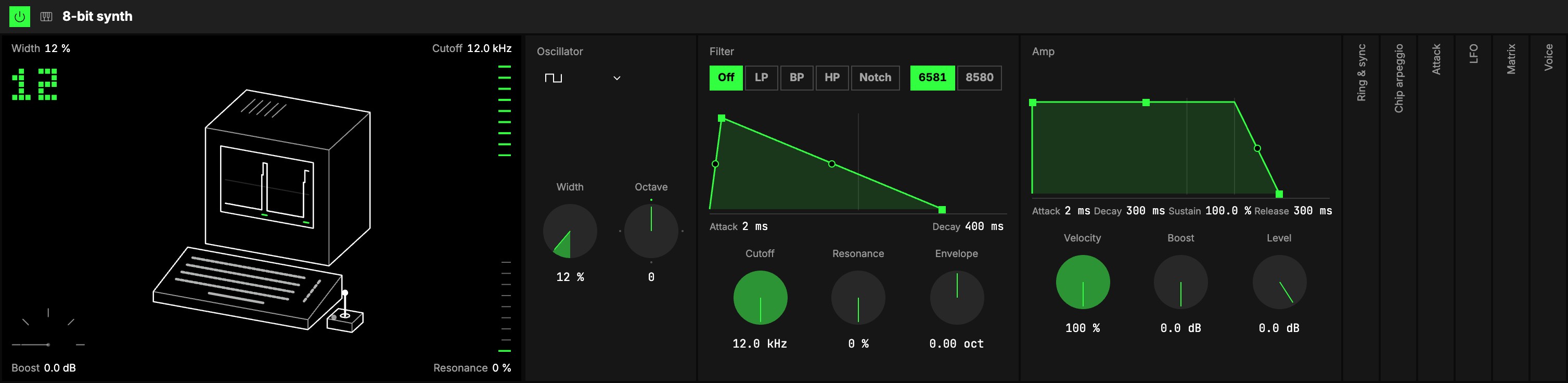
Each note has one oscillator with the chip's waves. All the notes then go through one filter, as
on the chip: a chord shares one sweep, and every new note restarts the filter's envelope. After the
filter, the boost. As it loads it is a plain square, the filter off and the boost off, three voices at
once (the chip had three).
Oscillator
| Control | What it does |
|---|---|
| 1Wave | The chip's waves: Triangle (soft, flute-like), Saw (bright), Pulse (the C64 lead) and Noise (higher with the key: drums, wind), or two or three of them combined (Saw + Tri, Pulse + Tri, Pulse + Saw, All three): the chip's buzzy, quieter mixes. |
| 2Width | The pulse's width, in every wave with a Pulse: a square at 50 %, thinner and more nasal towards the edges (30 sounds as 70). |
| 3Octave | The whole instrument up or down by octaves. |
Filter
One filter for every note, over the chip's range (30 Hz … 12 kHz).
| Control | What it does |
|---|---|
| 4Mode | Off (no filter), LP (low-pass, darker as the cutoff falls), BP (band-pass, narrow and nasal), HP (high-pass, thinner) or Notch. |
| 5Chip | Which SID the filter sounds like: the 6581, the first one, dirty and dark, distorting with resonance, never closing all the way; or the 8580, clean. |
| 6Cutoff | Where the filter works. |
| 7Resonance | A peak at the cutoff, up to a whistle. The 6581's is weaker and rougher. |
| 8Envelope | How far the filter envelope moves the cutoff, up or down, in octaves. |
9The filter envelope is drawn above the knobs: an Attack and a Decay back to the cutoff.
Drag a point, or type a value under it; bend either from its round handle. It has no sustain: it rises
and falls whether the key is held or not, and every note restarts it, for the whole instrument, rising
from wherever it is.
Amp
10The envelope of each note's level, drawn above the knobs: Attack, Decay, Sustain and
Release. Then 11Velocity (how much a note's velocity moves its level; the chip had none: at 0 every
note is full), 12Boost and 13Level.
Boost is the analog boost: warmth at a few decibels, a driven amp near the top. At 0 it is off, and
the level stays about the same as it rises. For more drive, tone or a Dry/wet, put a Saturator after it.
Attack, Decay and Release can be bent: see Envelopes. The chip's
own shape is a fall fast at the start with a long tail: Decay and Release curves at about 60 %.
Ring and sync, the chip arpeggio, Attack
These groups start folded; open one from its column.
- 14Ring & sync: each note has a partner at the Interval above it (and Fine, a few cents
off it for a slow beating). Ring flips the triangle with the partner: bells and metal (only
Triangle and Pulse + Tri ring, as on the chip). Sync restarts the wave at the key's rate while it
runs at the partner's: sweep the Interval for the sync scream. The note keeps the key's pitch either
way. - 15Chip arpeggio: 2nd, 3rd and 4th, each a number of semitones above the key, and
Speed, steps a second. One key then plays a chord the way C64 tunes did, as a fast arpeggio on one
voice: 50 steps a second is the chip's frame rate. All three at 0: no arpeggio. Major: 4, 7, 12;
minor: 3, 7, 12. For arpeggios in time with the music, use the Arpeggiator before it instead. - 16Attack: the chip's drum tricks. Noise plays noise instead of the wave for this many
milliseconds at each strike; Drop starts the note this many semitones above the key and falls to
it in Time.
LFO, Matrix, Voice
- 17LFO: one of the Orbiter's LFOs, its Amount,
and a Delay: each note brings the LFO in over this time, the delayed vibrato of the C64 leads.
Its share on the filter and the boost comes in at once. - 18Matrix: the Matrix every notes instrument shares. The LFO
can move Pitch, Width, Cutoff, Interval and Boost; velocity, the key, pitch bend,
pressure, the mod wheel and a random value per note move Pitch, Width, Interval, Level
and Vibrato; bend, pressure and the wheel move Cutoff and Boost too (one filter and one
boost for every note), and can bring the LFO in. LFO › Width is the classic moving pulse. - 19Voice: Mono, Legato, Glide and Voices (3 as it loads, up to 16).
The screen
20The home computer. A monitor, the keyboard under it and a joystick. The wave plays on the
monitor's glass in 8-bit steps, through the filter and the boost, and lights while a note sounds; the
pulse's width is the accent under it. The playing note lights its key, the fire button lights at each
strike, and the stick leans with the mod wheel.
The corners: Width as a number, Boost as a meter, Cutoff and Resonance as ladders.
Starting points
| Sound | Set |
|---|---|
| Pulse lead | Width 12 %, Matrix: LFO › Width 30 %, LFO › Pitch 3 %, LFO Delay 300 ms, Release 300 ms |
| Filter bass | Width 30 %, LP on the 6581, Cutoff 400 Hz, Resonance 60 %, Envelope +3 oct, filter Decay 250 ms, Mono and Legato, Glide 40 ms |
| Chip chord | Width 25 %, arpeggio 4 · 7 · 12 at 50 steps/s |
| Sync scream | Saw, Sync on, Interval 19, Matrix: Mod › Interval 100 %, Boost 9 dB |
| Ring bell | Triangle, Ring on, Interval 19, Fine 7, Decay 1.2 s, Sustain 0 % |
| Kick | Triangle, Octave −2, Noise 8 ms, Drop 36 st over 60 ms, Decay 200 ms, Sustain 0 % |
| Snare | Pulse, Noise 40 ms, Drop 12 st over 40 ms, Decay 180 ms, Sustain 0 % |
| Hot SID | Pulse + Saw, BP on the 6581, Resonance 70 %, Boost 18 dB |
| Closed hat | Noise, Octave +2, HP on the 8580 at 6 kHz, Decay 45 ms, Sustain 0 % |
| Tom | Triangle, Noise 3 ms, Drop 7 st over 120 ms, Decay 380 ms, Sustain 0 %: play it on several keys |
| Zap | Width 20 %, Drop 48 st over 160 ms, Decay 220 ms, Sustain 0 % |
Drums
The 8-bit synth plays the drums of the old games: a burst of Noise at the strike and a Drop onto the
key make kicks, snares and toms; the Noise wave makes hats and cymbals. The noise follows the key, so
a hat plays brighter up the keyboard (Octave +2 puts it there from any key). One instance plays one drum
sound well: for a kit, put one in each of the Orbiter's dimensions, or play the sounds from different
keys.
Mapping
In the Studio's Map mode every knob can follow an axisUno de los tres controles de interpretación de un Orbiter: X, Y y Z., and Chip, Ring, Sync,
Mono, Legato and the LFO's on/off a toggle: see Edit. Width, the Interval (with
Sync on), Cutoff and Boost are the ones to try first.
In a room
Every player in a roomUna sesión a la que varias personas se unen para tocar juntas los mismos Orbiters, cada una en su dispositivo. hears the same notes with the same sound: the arpeggio,
the drop, the noise hit, the LFO delay and the filter envelope all start on each note's strike, which
everyone shares. The noise itself differs a little between players. Pitch bend, pressure and the mod
wheel stay your own.