Limiter
Two limiters make a sound louder while its peaks never pass a ceiling: the Limiter, three controls
like a mastering limiter, and the One Limiter, one knob that makes a mix louder one way and denser
the other. A limiter is a compressor with an infinite ratio: whatever would go over the ceiling is
turned down just enough, a moment before it arrives. Its home is the end of the
StarEl cuerpo del Orbiter donde se junta el sonido: su mezclador combina el Mundo y el retorno de la Luna, y sus propios efectos suenan sobre todo.'s chain, the last thing before the speakers; it works on a World too.
The Limiter loads with its Threshold on its Ceiling (−1 dB) and the One Limiter at Amount 0: a sound
under the ceiling passes exactly as it came in, 1.6 ms later. A limiter looks ahead to catch each peak
in time, so it always plays that little late.
Neither limiter can go on a Moon. A Moon plays beside its World, and the limiter's small delay would
make the two copies interfere.
Limiter
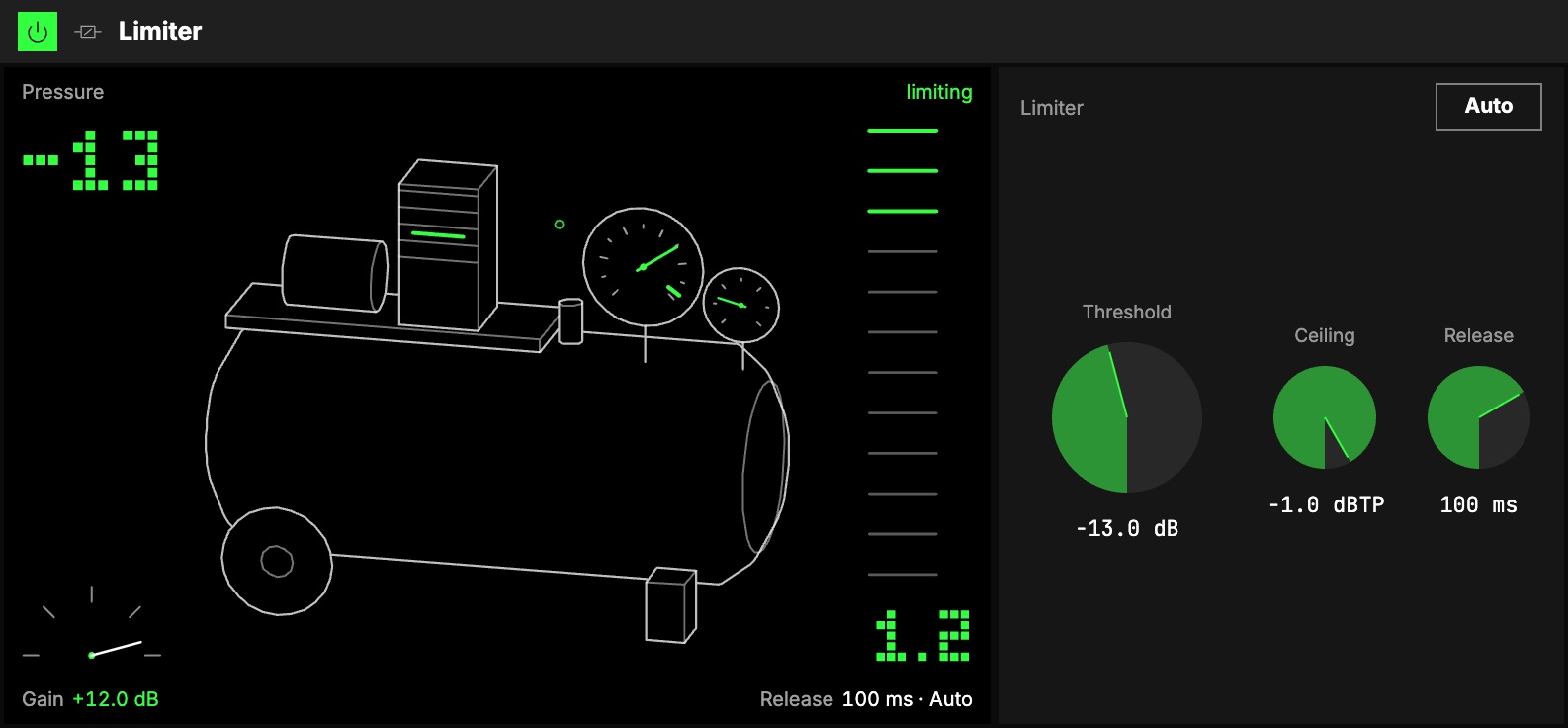
Limiter
| Control | What it does |
|---|---|
| 1Threshold | Where limiting starts, −24 … 0 dB (−1 dB as it loads). Pull it down and everything gets louder by the difference between the Ceiling and the Threshold, while the peaks above the Threshold are held at the ceiling. Threshold −7 dB with Ceiling −1 dB: 6 dB louder. |
| 2Ceiling | The highest peak that comes out, −12 … 0 dB (−1 dB as it loads). It counts the peaks between the samples too (dBTP), the ones a converter or an MP3 would clip. It is the Limiter's output level: there is no Dry/wet or Level, so nothing ever passes it. |
| 3Release | How fast it lets go after a peak, 1 ms … 1 s (100 ms as it loads). Short is louder but can distort low notes; long is cleaner but can pump. |
| 4Auto | On as it loads. A lone peak lets go at Release, and a long loud passage lets go more slowly, so it neither crackles nor pumps. Off, Release alone sets it. |
The screen
An air compressor. The sound is the air. The 5pump on top pushes it into the tank: its piston
works harder the more gain the Threshold gives. The 6big gauge reads the pressure that comes out,
the output level, with the ceiling as its mark. When the sound would pass it, the 7safety valve
lets the extra air out in puffs, more the harder the Limiter works, and the 8small gauge reads how
much it lets out: the reduction. The big number is the Threshold and the half-ring under it the
Ceiling; underneath, the gain the Threshold gives and the Release. The 9ladder on the right lights with
the reduction, and the number under it says how much in dB.
One Limiter
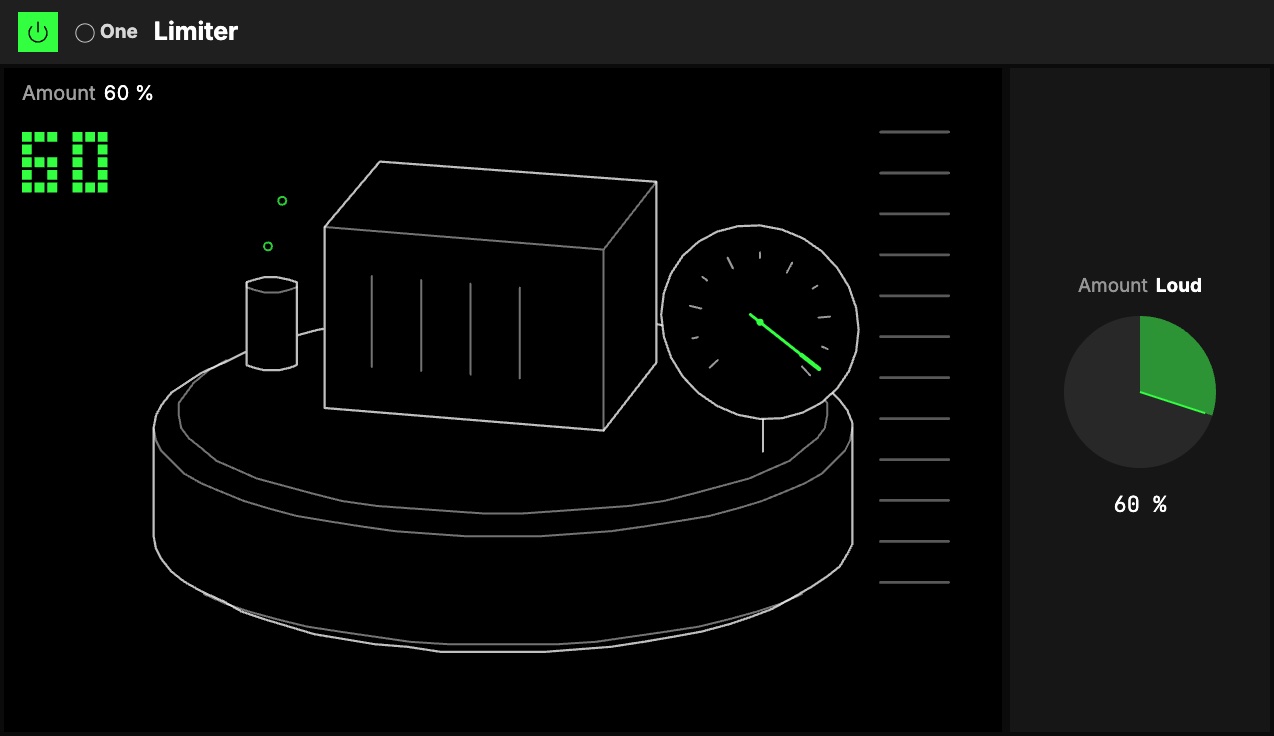
One knob, 1Amount, with the One badge. It goes both ways from 0, and each way is a different limiter;
at 0 it does nothing. Either way, once you turn it, no peak passes −1 dB.
- Turn it right: Loud. Up to 12 dB louder, with a fast release: punchy and loud, the classic
mastering push. - Turn it left: Dense. The same push with a slow release, and the level it added taken back off:
the mix gets thicker and more even without getting louder. Safe to move on an axis.
Its screen is a smaller machine, a pancake compressor: one 2gauge for the output, with the ceiling's
mark, and the 3safety valve's air while it limits. The big number is Amount, and the 4ladder on the right
shows the reduction.
Try it
- Catch the overs. Limiter at its defaults on the Star: nothing changes until a peak would pass
−1 dB. - Ready for streaming. Threshold −4 dB, Ceiling −1 dB, Auto on: 3 dB louder, peaks at
−1 dBTP. - Loud master. Threshold −8 dB, Ceiling −0.3 dB, Release 60 ms, Auto on. Watch the
ladder: past 6 dB of reduction most mixes start to suffer. - Smashed drum bus. Threshold −13 dB, Ceiling −3 dB, Release 20 ms, Auto off.
- One knob on the Star. One Limiter at +40: louder and finished. At −40: the same glue,
the level kept.
Mapping
Every Limiter control can be mapped to the Orbiter's axes, and the One Limiter's Amount maps like any
knob: see Edit.