Vibrato
The Vibrato makes the pitch waver, evenly above and below the note: a singer's vibrato on a synth
lead, a slow warble on a pad, a warped tape at a slow rate and a big depth. It goes in any effects rack,
most often as an insert on a lead, a pad, an organ or a voice.
The note wavers without getting louder, softer or wider. That is the difference from a tremolo,
where the level goes up and down, and from a chorus, which mixes wavering copies with the original.
The Vibrato loads at Depth 0 ct: the sound passes exactly as it came in, with no delay. Turn Depth up
to start the waver.
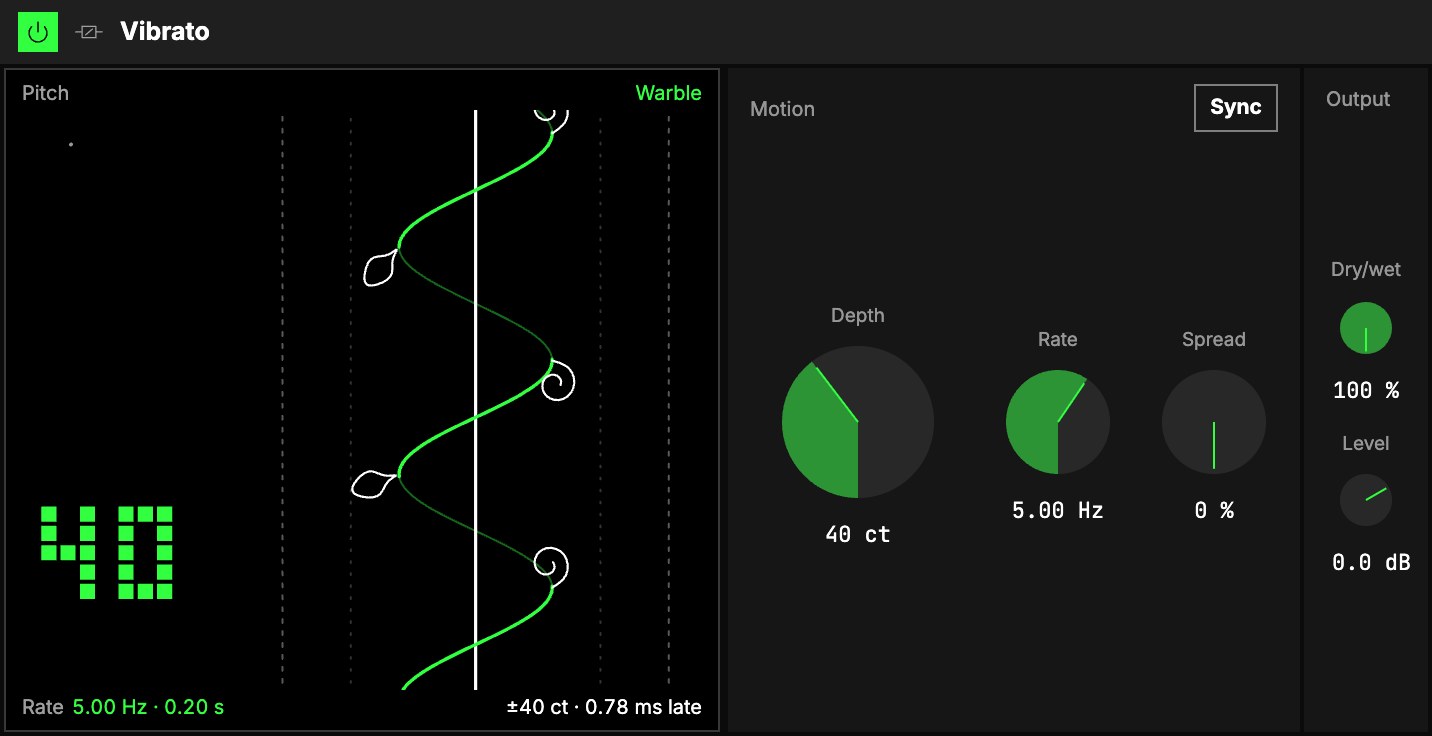
Motion
| Control | What it does |
|---|---|
| LFO | The waver is one of the Orbiter's LFOs. The menu on the tab picks which (the dimension's X as it loads), the hexagon switches the waver on and off. Its Rate in (Hz, Beats or a value of the World), Rate, Shape and LFO depth are that LFO's own, shared with whatever else reads it. |
| 2Depth | How far the pitch swings above and below the note, in cents: 100 ct is a semitone, up to 300 ct (three semitones). 0 ct as it loads: the sound as it came in. |
| 4Spread | Swings the two sides apart: 0 % as it loads (both sides together), 100 % one side up while the other is down. |
Depth in cents. Depth means the same thing at every Rate: 25 ct is a quarter of a semitone each
way, whether the waver is slow or fast. A singer's vibrato is about 10 … 50 ct at 5 … 7 Hz; a gentle
shimmer is under 12 ct, a warble 40 ct and up, and past 150 ct it turns into a siren. The knob is finer
near 0: its first half covers 0 … 60 ct, the second half 60 … 300 ct. At the slowest rates the
deepest settings are held back a little, and the screen says (held).
The LFO's Rate. Slow (under about 1.5 Hz), the pitch sways or wows like a warped tape. Around 5 Hz it sings.
Fast (above 8 Hz), it flutters; near 21 Hz, the LFO's fastest, it turns into a buzz. Depth is in tune with a sine; another Shape bends the pitch its own way (a square jumps between two pitches).
On the beat. With the LFO's Rate in on Beats, the waver is locked to the Orbiter's beat, not only to its speed:
each waver starts on the beat, in tune and rising. Every player in a room wavers together. Start, stop or jump the
transport and the waver slides back onto the beat without a click.
Output
| Control | What it does |
|---|---|
| 5Dry/wet | How much of the wavering sound you hear. 100 % as it loads: a vibrato. Lower, the dry note blends back in. 0 %: the sound as it came in. |
| 6Level | The level after the effect. |
Dry/wet below 100 % is a chorus-like blend. The wavering copy plays a few milliseconds behind the
dry note, so at 50 % the two beat against each other: a shimmer, slightly hollow, the sound of a
simple chorus. For a lusher, wider blend, with several voices and a low cut that keeps the bass
steady, use the Chorus instead.
On a MoonAn Orbiter body that works as a send and return: the World is sent to it, and it returns only its effect, which the Main mix adds to the dry sound. it returns only its wavering copy, at Dry/wet 100 %, next to the
World's dry sound: the two together sound like a chorus (see Audio effects).
The screen
7A runner bean. A runner bean twines round a string, and the string is the note.
- Rate is the wavelength: the faster the waver, the shorter the turns.
- Depth is how far the bean swings from the string, and the small number in the bottom-left
corner. At 0 the bean is gone and the string turns grey: Still · 0 ct. - Spread is a second, thinner bean: the right side.
- The word above the picture says Shimmer, Sing, Warble, Wow or Flutter.
Try it
- A singer's vibrato on a lead. Depth 25 ct, the LFO's Rate 5.5 Hz. Map Depth to an axis and bring it in on the long notes only.
- A warped tape on a pad or a piano. Depth 60 ct, the LFO's Rate 0.8 Hz: the pitch sways slowly, like a record off centre.
- A wide shimmer. Depth 10 ct, the LFO's Rate 6 Hz, Spread 100 %: the two sides waver apart and the sound opens up.
Mapping
Every Vibrato control can be mapped to the Orbiter's axes, and the LFO's on/off to its toggles: see Edit.