Saturator
Two saturators add warmth, then grit: the Saturator, with every control in reach, and the One
Saturator, one knob with a warm crunch one way and a tube's sweetness the other. A saturator pushes a
sound into a curve that rounds its peaks off, which adds harmonics: a little thickens a sound, a lot
distorts it. Both go in any effects rack, most often as an insert on drums, a bass, a synth or a
voice.
The level stays where it was. Turning Drive up makes the sound thicker, not louder, so you can
judge the colour by ear.
The Saturator loads at Drive 0 dB and the One Saturator at Amount 0: the sound passes as it came in.
Saturator
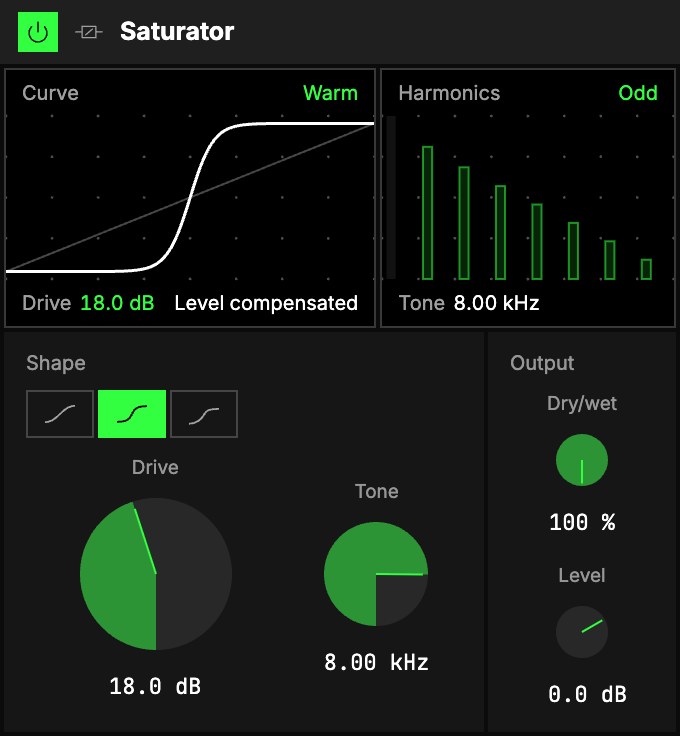
Shape
| Control | What it does |
|---|---|
| 1Character | The curve. Soft is the gentlest; Warm (as it loads) is rounder and thickens as it saturates; Tube is lopsided, which adds even harmonics: body and sweetness. It switches while the sound plays, without a click. |
| 2Drive | How hard the sound is pushed into the curve, 0 … 40 dB: warmth at first, crunch further up. 0 dB (as it loads) is off. |
| 3Tone | A low-pass on the saturated sound only, 500 Hz … 20 kHz (8 kHz as it loads): lower tames the fizz. The dry sound is never filtered. |
Output
| Control | What it does |
|---|---|
| 4Dry/wet | Balance between the dry and the saturated sound. 100 % as it loads. |
| 5Level | The module's output level, dry included. |
The screens
6Curve. The white line is what the Saturator does to the wave: the thin diagonal is the
sound untouched, and the more the white line flattens at the top and the bottom, the more the peaks are
rounded off. It is drawn at its full height whatever the Drive: the picture is the shape, not the
loudness. Above, the Character (Off at Drive 0); below, the Drive.
7Harmonics. One bar for each harmonic the curve adds, the lowest on the left, with a
marker where Tone starts taking them away. The word above says Odd with Soft and Warm, and
Odd + even with Tube.
One Saturator
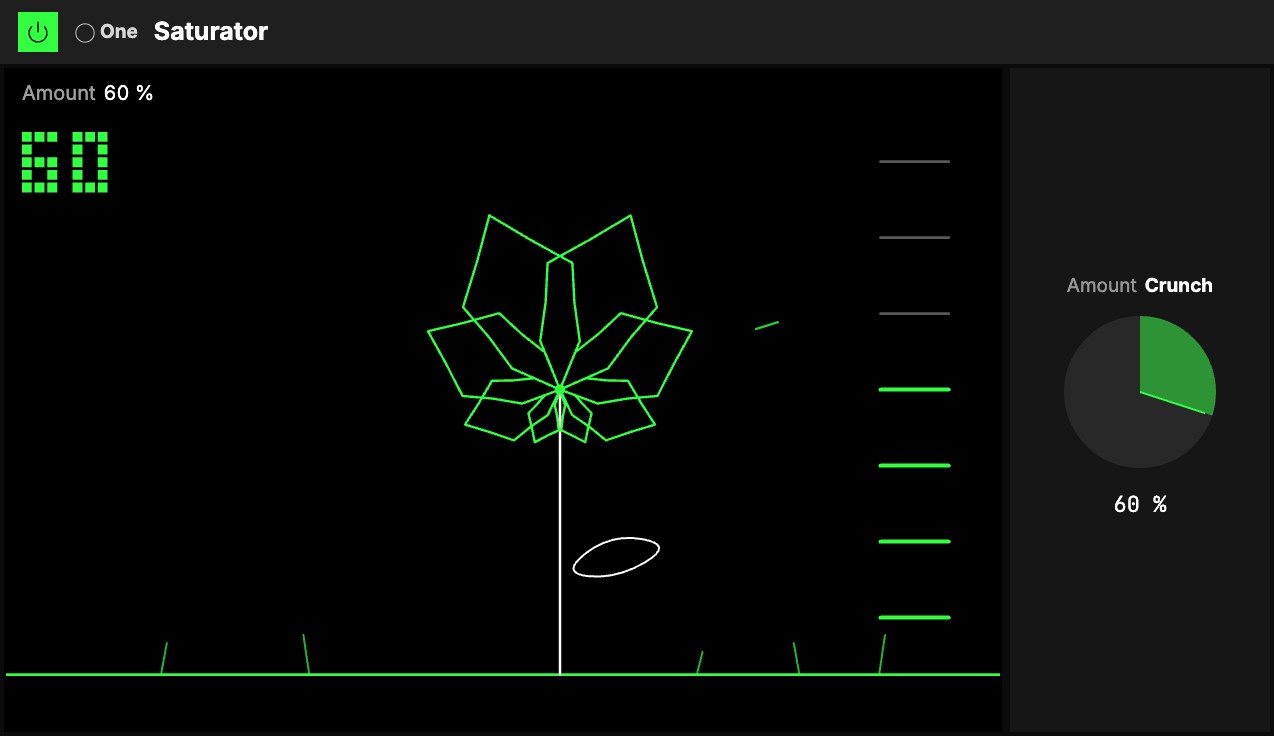
One knob, 1Amount, with the One badge. It goes both ways from 0, and each way is a
different saturator; at 0 it does nothing, and either way the level is kept.
- Turn it right: Warm. From warmth to a little crunch, with the top end closing as
you turn. - Turn it left: Tube. Body and sweetness, with the top end left open.
Map Amount to an axisOne of an Orbiter's three performance controls: X, Y and Z. and one gesture goes from the tube, through the clean sound,
to the crunch.
The screen
2The Bloom. A plant whose petals are the harmonics the knob adds. At 0 it is a closed
bud; turned either way, the stem grows and it flowers. To the right (Warm) it is a star of pointed
petals: one pair for each odd harmonic loud enough to hear, each as long as it is loud, the outer ones
shortening as the top end closes; past half way the petals grow teeth and sparks drift off: the crunch.
To the left (Tube) it is a tulip: a cup of three broad petals, with a stamen inside for each even
harmonic, and a soft glow around it past half way. The ladder on the right counts the harmonics you
can hear. The big number is Amount: drag it up or down to turn it, as you would the knob. While sound plays the plant breathes and leans with its
level; at rest it is a still picture.
Try it
- A thicker bass. Character Tube, Drive 10 dB: the bass gains harmonics above its note and is easier to hear on small speakers.
- Drums with bite. Character Warm, Drive 18 dB, Tone 6 kHz, Dry/wet 50 %: the crunch sits under the clean hits.
- A soft edge on a pad. Character Soft, Drive 6 dB: a little density, no audible distortion.
- Clean to crunch on an axis. Map Drive from 0 to 24 dB. The level holds, so only the colour moves.
Mapping
Drive, Tone, Dry/wet and Level can be mapped to the Orbiter's axes, and the One Saturator's Amount maps
like any knob: see Edit.