Random
Random moves a note up or down, by chance: an arpeggio that sometimes jumps an octave, a step line
that wanders a degree up or down in the key, a bass that flips between root and fifth. At a low
chance it adds the odd variation; at a high one it turns into a new melody built on the old one.
It is a MIDI effect: it sits in an Orbiter's chain before the instrument, after the generator if
there is one. A change applies from the next note: a note already sounding keeps its key, and its
release sounds there.
Random loads with Chance at 0 %: every note passes exactly as it came in. Raise Chance and notes start
to jump an octave up or down.
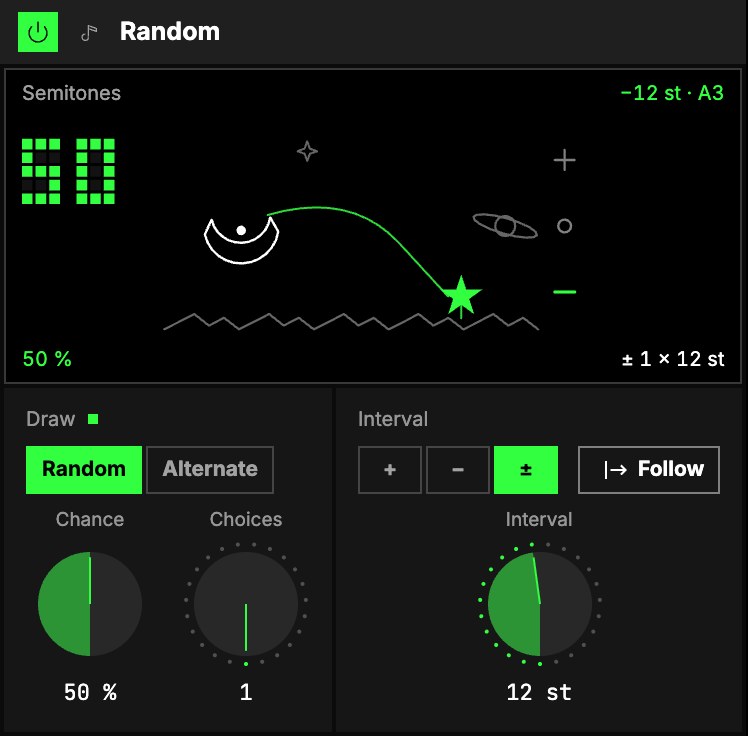
Draw
| Control | What it does |
|---|---|
| 1Chance | How likely a note is moved. At 0 % no note moves; at 100 % every note does. |
| 2Choices | How many intervals a moved note can land on, each way. With Choices 3 and an interval of 12 st, a note can move one, two or three octaves. |
| 3Random or Alternate | How a moved note picks its move. Random draws one of the moves for each note. Alternate takes the moves in turn: up, down, further up, further down… A chord's notes take successive places, so a chord spreads out. |
The light after Draw flashes when a note was just moved.
Interval
| Control | What it does |
|---|---|
| 4+, − or ± | Which way a note moves. ± (as it loads) moves it either way, so a line drawn around itself keeps its register. |
| 5Interval | One step of a move. In semitones (1 … 24 st, 12 st as it loads: an octave), or, with Follow on, in degrees of the scale (1 … 14 deg, 7 deg as it loads). |
| 6Follow | On, the interval counts degrees of the Orbiter's scale, so a moved note stays in the Orbiter's key. Off (as it loads), it counts semitones. Turn Follow on once the Orbiter has a key: with no scale set, a degree is just a semitone. |
Random moves the line in the key, it doesn't correct it: for a strictly in-key result, put Scale
after it.
The edges
A move past the lowest or the highest MIDI note folds back by whole octaves, so the note keeps its
note name. There is no range of its own: put Pitch after Random to keep a register.
The screen
7The screen shows a dream from Méliès' A Trip to the Moon (1902): where the last note went among the
moves it could take.
- The crescent moon with its dreamer is the note coming in.
- The small stars are the moves, one each, at their real height: higher is up.
- The big star, held up on a staff from the rocks, is the move the note took, with an arc from
the moon. - Saturn lights when the note stayed where it was.
- With Alternate, a dotted line joins the stars in the order the walk takes them.
The corners and the crosshair
The number at the top left is Chance: drag it up or down (double-click resets it). At the top
right, Direction (up, both ways or down) and at the bottom right, Mode (Random or Alternate)
are rows of dots: tap to take the next. The crosshair is the sky: drag it sideways for
Choices (how many stars) and up or down for Interval (how high they reach, in semitones or
degrees); the triangles on the edges move one of the two alone.
Try it
- An arpeggio that leaps. After an Arpeggiator, before the instrument: Chance 30 %, ±, Interval 12 st. Now and then a note jumps an octave.
- A line that wanders in the key. With the Orbiter's key set: Follow on, Interval 1 deg, Choices 2, Chance 50 %.
- A bass between root and fifth. On a one-note bass line: +, Interval 7 st, Choices 1, Chance 40 %.
- More, the further you move. Map Chance to an axis: at rest the line plays as written, and it loosens as the axis moves away from rest.
Mapping
AxesUno de los tres controles de interpretación de un Orbiter: X, Y y Z. can drive Chance, Choices and the interval: a World that moves away from the
centre plays a looser line (Chance), or a wider one (Choices). Random · Alternate and Follow can be
toggled. The two intervals map separately, so switching Follow never changes what a stored number
means.
In a room
Every player in a roomUna sesión a la que varias personas se unen para tocar juntas los mismos Orbiters, cada una en su dispositivo. hears the same notes moved the same way.